
The Optimistic Nihilists
The new temptations and dangers of believing in nothing

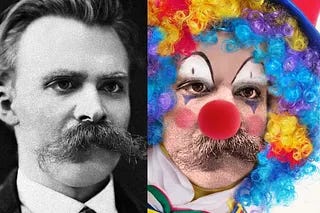
Life is utterly meaningless, but this is a great opportunity to have fun creating our own meanings—that’s the latest postmodern self-help mantra. The trend known as optimistic nihilism is a twenty-first-century spin on the doctrine that existence is without ultimate purpose or justification.
Type the question What is the meaning of life? into any search engine and there’s a high likelihood that you’ll be fed the optimistic nihilism creed as an answer. It’s trendy among the under thirties. The YouTube video “Rick and Morty—Finding the Meaning of Life” extrapolates optimistic nihilism for teenagers, claiming that although life is meaningless we should focus on “the stuff we actually enjoy.”
A video by YouTuber Kurzgesagt—In a Nutshell (who has nearly 17 million subscribers), which advocates optimistic nihilism has 15 million views. It tells us, “If the universe has no purpose then we get to dictate what its purpose is … We are truly free in a universe-sized playground, so we might as well aim to be happy.”
While mainstream lifestyle articles talk about ‘getting into Neo-Nihilism’ which is ‘very much in’ and find it ‘soothing to conclude that nothing really matters’, Self-help videos like “A GUIDE TO NIHILISM: Nothing Matters, Life Is Meaningless and Remember To Have Fun!” and “How I Use Optimistic Nihilism to Manage Depression” propose it as a cure for the mental illness that has afflicted Generation Z.
Celebrities like Ricky Gervais expound the basic tenets[II1] : “Why are we here? Well, we just are …There’s loads of reasons why you can say we’re here … it’s to eat and drink and make friends and have fun.”
The belief (or anti-belief) has also found its way into therapy. One American psychotherapy service for adults, adolescents and couples claims: “Optimistic nihilism can be an incredibly empowering belief … The optimistic nihilist looks at a world lacking in meaning and purpose and sees the opportunity to create their own … You are free to make your own meaning and discover what makes you happy.”
This formula is also being used to bolster the claims of self-improvement business bloggers[II2] like Ivaylo Durmonsky, who writes, “Optimistic nihilism is the realization that the lack of meaning in the world and the universe as a whole can be liberating. Precisely because there is no inherited meaning in life, there is no cosmic plan forcing you to act a certain way, we are the ones who can create our path.”
Optimistic nihilism is spreading everywhere and it appears to be the illegitimate fusion of American positivity culture with the philosophy of Friedrich Nietzsche. It’s a nihilism lite that has shed all of the terrifying aspects of the nihilist tradition.
Real Nihilism
Nihilism has been around at least since the advent of Buddhism in the fifth century BCE. It took on a new meaning in the 1860s, as an insurrectionary Russian terrorist movement intended to overthrow the church, state and monarchy. Many nineteenth-century commentators were concerned about the rise of atheism. Nietzsche declared “God is dead. We have killed him” and his work examines the consequences: not just of atheism but of the lack of belief in anything.
What Nietzsche describes as the “transvaluation of all values” re-emerged with the Beatniks and existentialists of the 50s and then with the sex and drug subculture of the hippies in the 60s and 70s. For them, the death of God and the destruction of all values were something to celebrate. We’re free to do anything we want was the ethos. Get high and have a good time. Fuck for freedom. Smash the system.
Nietzsche’s great insight, however, was that if you destroy all established values, you also end up destroying the basis of your entire existence. This is the full context from which his short God is Dead quote/meme is usually extracted:
God is dead. God remains dead. And we have killed him. How shall we comfort ourselves, the murderers of all murderers? What was holiest and mightiest of all that the world has yet owned has bled to death under our knives … What festivals of atonement, what sacred games shall we have to invent? Is not the greatness of this deed too great for us? Must we ourselves not become gods simply to appear worthy of it?
For Nietzsche, nihilism was a devastating philosophy, the great problem to be transcended. As he intimates, human beings might not be up to the task of inventing new values and “sacred games.” Most, if not all of us, will fail to “become gods.” We are destroying our previous values without being able to replace them.
So why are so many people drawn to optimistic nihilism today?
Optimistic Nihilism as Consolation
Optimistic nihilism is a consolation for those who feel that they are under-achievers or failures. There is evidence for this in the thousands of comments below YouTube videos, by converts who feel optimistic nihilism has saved them from low self-esteem and depression. The video by Kurzgesagt cited above has 54,000 comments, many of them from readers who share these and similar sentiments:
“This is actually the kind of mindset I have after I recovered from depression. I'm just like, "Eh, it's my life so I should do whatever I want." I don't care if I'm 'not successful' or “wasting my time” or “not working hard enough” … What's wrong with trying to spend my time the way I enjoy?”
“It’s very comforting to not have a meaning to life. there’s no pressure you just live. I don’t have to worry about appeasing a greater being or fulfilling my purpose.”
“This is exactly my way of thinking, and honestly as much as it gets me sad, it also helps me deal with the things I consider embarrassing, and my regrets.”
Optimistic nihilism can alleviate painful self-doubt and fear of failure. “Optimistic Nihilism allows you to do what you want free from your own emotions and needs you can just be happy from doing nothing,” comments one viewer of a TED X video by Elias Skjoldborg:
“If you don't ever set up goals, you will never be disappointed when you fail trying to attain them. There is no meaning to life.” “Nothing matters means that: BEING HAPPY is what matters!” claims another viewer of a self-help video that begins with jaunty flute playing.
Optimistic nihilism encourages people to feel that none of their personal failures matter because everything in the cosmos is meaningless; every life ends in death; the Sun will eventually destroy planet Earth, all life will be destroyed in the heat death of the universe. So it no longer matters if you flunk your exams or your partner of twenty years has cheated on you or your career has prematurely ended because, measured against this cosmic scale, human success and failure have no meaning. Relax, the mantra goes, nothing in the universe lasts or has any purpose.
But what may begin as a consolation ends up exacting a heavy price.
My generation, Generation X—the slacker generation—is the living proof of this.
Prior to its infection of Generation Z, nihilism took hold in the postmodern arts scene of the 1990s. I myself was a self-proclaimed nihilist for a good fifteen years. Like many of my peers, I took a sadistic pride in destroying other people’s belief systems; it was clear to us that nihilism meant being counter-cultural, tearing down the establishment, hierarchies, capitalism, binary thinking, morality and so on. We hadn’t read enough Nietzsche to understand the dangers.
Nihilism caused us a lot of psychological harm. Once the thrill of thinking you’re a rebel without a cause wears off, there are casualties. Our icons were Kurt Cobain, David Foster Wallace, Philip Seymour Hoffman, Chester Bennington and Alexander McQueen - and all these nihilistic artists had serious addiction issues and ended up killing themselves. The psychological despair nihilism engenders has also cost more than a few lives in my peer group.
When everything is meaningless, nothing matters, including your own life. Optimistic nihilism is an oxymoron and betrays a shallow understanding of what nihilism actually does to people.
Why Is Optimistic Nihilism So Fashionable?
So, why is it so hip to proclaim yourself an adherent to this philosophy?
Sociologist Zygmunt Bauman argues that the current stage of consumer capitalism no longer offers individuals the tools necessary to thrive or develop:
For Bauman, consumer capitalism has produced a culture of global homogeneity, mediocrity and uniformity in which traditional, local and transcendent meanings are destroyed and replaced by uniform systems of mass production, consumption and communication. These processes make us all generic and average, like the mass-produced products we buy. Bauman describes it as “‘mass society’ producing ‘massmen’ on a massive scale.” Consumerism propagates rootlessness. It makes us feels like nobodies, citizens of nowhere who have failed to achieve individuation or to find meaning in our lives.
If Bauman is right, this may be one of the reasons why optimistic nihilism has taken such hold. For if people feel mediocre, if they feel that they are failures and generic nobodies, they may be comforted by feeling that everyone else is failing too. Optimistic nihilism, then, can begin with resentment and schadenfreude. I can summon a sense of the meaningless of everything for all eternity in order to make my sense of personal insignificance less painful.
In this sense, optimistic nihilism is an antidote to the anonymity and insignificance many people feel. But it is a dangerous antidote.
The Stages of Descent
Nihilists are plagued by the question why? If nothing matters, what is the point in holding down a job, finishing a book, attempting to have meaningful relationships? Why be polite or drink in moderation? Why become skilled at anything? Why be sociable or even ethical? To be a true cosmic nihilist is to accept that every work of art, political movement, scientific discovery and work of genius will be meaningless one day. So why bother to even begin any activity? Why undertake anything? Why care?
Nihilists often become unemployed because they scorn meaningful employment and all the values that their co-workers believe in. They’re unpleasant to be around, and they find it difficult to endure a world in which they are surrounded by institutions that uphold existing values, be they law, truth, beauty, knowledge or progress. So nihilists tend to become isolated.
For a while, putting all the stupid people who believe in things down suffices as a project in itself and elevates the ego. You can despise all the intellectually inferior people who fail to grasp that nothing they are doing has any value. You can live in this state of nihilistic intellectual superiority for a few years (and I did) but then you are likely to seek distraction from your own despair. This often leads to substance abuse. In the absence of any belief system, there is no reason to get out of bed in the morning, other than addiction. Then comes the problem of what you are going to do with all that meaningless time that lies ahead in your meaningless life in the meaningless universe.
Should you have kids? No—why pass the burden of your meaninglessness onto someone else? Should you find a job that helps others? No—why take on the burden of other people’s futile existences? Without goals and values, you become demotivated. There is no anchor in any meaning beyond the self, and even the self has no inherent value.
By now, you’re on the downward slope. Cosmic nihilism always gives way to moral nihilism. If morals are just fragile fictions created to conceal the vast indifference of the universe, then why not lie, cheat and steal? There is no God to judge you, and how could any nihilist cling to such pathetic myths as reason or justice?
People can inhabit this state of moral nihilism for only so long, though, until they become isolated, ostracised or prosecuted. Nihilists break laws to test the boundaries of their own indifference. In the words of Nine Inch Nails in their nihilist Gen X anthem “Hurt,” “I hurt myself today, to see if I still feel. I focus on the pain, the only thing that’s real.”
Law- and taboo breaking lead to self-abuse and depression. Depression and lack of meaning are interconnected. Depression is particularly hard for a nihilist to overcome because there is nothing with any meaning above the spiralling whirlpool of pointlessness that they can reach up towards. This leads them to hate fully functioning people with their stupid social constructs and beliefs.
The nihilist then survives on the energy found in hatred. But even then, the nihilist is not free of values, but vampirically feeds on the values of others. In this way, many nihilists get involved with antagonistic political movements that are simply out to destroy the existing order with no real plans beyond destruction as an end in itself. Very often these movements masquerade as fights for good causes—equality, justice etc. Many a nihilist masquerades as an anarchist, but the true nihilist knows that even do-goody values are just meaningless social constructs.
Moral nihilism then gives way to existential nihilism and the nihilist realises that even the self who thinks and feels and poses these questions is meaningless. There is no point to individual existence, so why go on?
There is an inevitability to the descent towards suicidal ideation. It is only lazy nihilists—the amateur dabblers, sophists and addicts—who stuck at the early stages of nihilist rebelliousness and are saved from the fall. Nihilism claims the lives of many who get sucked into its swirling vortex.
Facing Suicide and Creating Your Own Values
Albert Camus, who grappled with nihilism all his life, claimed that:
There is but one truly serious philosophical problem, and that is suicide. Judging whether life is or is not worth living amounts to answering the fundamental question of philosophy.
Nietzsche was clear that there are two kinds of nihilism: negative (or reactive nihilism), in which values are destroyed and you suffer to the point of self-negation; and positive (or active nihilism) in which a new kind of person, who has endured the hell of facing self-destruction will emerge—the Übermensch. After “doing philosophy with a hammer” and confronting his own oblivion, the Übermensch will rise like a phoenix from the flames and create his own values.
For Nietzsche, you can’t reach positive nihilism until you’ve been through the hellish passageway that is the negative, until you have skirted the very edge of suicide and then decided to live.
Today’s optimistic nihilists are trying to skip all the necessary suffering and pretend that there’s an easy shortcut to a happy ending. Their belief that you can create your own meanings and values is a pop culture version of Nietzsche’s Übermensch. But unlike Nietzsche’s, this hip nihilism doesn’t confront the darkest question that lies beyond even suicide. It does not ask Why shouldn’t I reject compassion and pity? It does not ask, as Nietzsche did, why shouldn’t I subscribe to an ethos of dominance and the will to power? Nietzsche would have scorned the idea that nihilism could be grounded in optimism, personal happiness and fun. He proclaimed, “Who will attain anything great if he does not find in himself the strength and the will to inflict great suffering?” Optimistic nihilism does not ask the question every moral nihilist must confront: Why should I respect the lives of others when my own is meaningless? Why not abuse, attack, rape and murder?
Nietzsche also believed that your average, everyday people would fail to become an Übermensch and would fall back on the Judeo-Christian moral framework he’d inherited. That such people would be lazy, trivial “last men,” seeking pleasures, camaraderie and superstition as short-term rewards.
Fun Is not Fun
Instead of asking, why shouldn’t I kill myself or others? optimistic nihilists ask, how can I have fun today? Stay on the sofa, finish your computer game, have another beer, hang out with your friends, go to the gym, skydive—why not? In this way, the concept of creating your own values degenerates into little more than living out everyday consumerist norms. You distract yourself as you dance around the edge of the void. Go on—have that extra slice of pizza. There’s no meaning in the universe, after all, but somehow you are still awesome.
In this way, optimistic nihilism degenerates swiftly into lazy, narcissistic hedonism. But even as a form of hedonism, optimistic nihilism is mediocre. Optimistic nihilists don’t advocate risking your life for the sake of happiness. They merely recommend that you have some fun until your meaningless life is over, and they do so under the pretence that this is what creating your own values means. No wonder videos by optimistic nihilists always feature footage of bungee jumping and rock climbing—holiday activities.
While the Existentialists of the 1940’s found their own solution to nihilism in fraught and heroic acts of rebellion (against Fascism and ‘tradition’), the heroic acts through which today's optimistic nihilists ‘create their own meanings’ tend towards adventure sports and taking Instagram photos of their lives within the banal everyday events of consumerism. I’m 'creating my own meaning’ by wearing yellow socks or getting a tattoo of a random anime character I found online.
There is a logical flaw at the heart of optimistic nihilism—for if there is no meaning in the universe then attempting to create meaning for myself is futile. As Wittgenstein proved in his theory of private language, the idea that someone can have their “own private meaning” is philosophical nonsense and delusional solipsism. There is no such thing as private language or private values—these things are, and always have been, social.
It follows then that if the self is a meaningless construct, then this self would be unable to create any new meaning at all.
Optimistic nihilism also fails to address the fact that human beings are “pattern-seeking primates” and “meaning-seeking animals.” By natural impulse, we seek patterns of meaning in our experiences and if we rob ourselves of the pursuit of meaning, we become demotivated and psychologically unwell.
Psychiatrist Viktor Frankl believed that the search for meaning is essential to wellbeing and developed the clinical practice of logotherapy on the basis of this insight. Existential psychiatrist Irvin D. Yalom provided empirical clinical evidence to show that that to live without goals, values or meaning produces considerable psychological distress. This claim has been backed up by psychologist Jerome Bruner in his 1990 book Acts of Meaning and by a 2015 clinical study conducted J. García-Alandete using “purpose in life tests,” which found a significant correlation between a sense of meaning and psychological well-being, and conversely a higher incidence of suicide among patients who could not find any meaning in life. “Meaning in life,” writes García-Alandete, buffers the association between risk factors for suicide and hopelessness.”
Optimistic nihilism may seem appealing to the young who want to avoid judgment and to attack the values of their elders, but using nihilism as your get-out-of-all-commitment-free card leads to costs that soon mount up. After years of practising the rejection of all values, you will find that you’ve led a life without purpose or goals and therefore without any achievements, pride, worth or connections, and hence without any shared rewards or joy. The pretence that you are happy soon begins to wear thin. You’ve proven the premise of nihilism by acting it out with circular logic—you have made your life truly pointless.
It’s particularly dangerous for people in their twenties to arrive at the nihilist answer-to-everything pre-emptively, before they have even attempted to find meaning or purpose in life. As a result, they won’t get to experience the richness of a lifetime spent in the pursuit of meaning, and they forbid themselves any appreciation of the many cultures that have spent millennia seeking higher meanings.
It is alarming to see so many of Generation Z expound optimistic nihilism as their belief system, and this may be one of the reasons why Gen Z are exhibiting record-breaking levels of depression, with 42% diagnosed with mental health conditions and 57% currently taking medication for such conditions. Optimistic nihilism is not just incoherent; it’s a dangerous form of social contagion.
Take it from an ex-nihilist and survivor—a meaningless life is nothing to be optimistic about, and those who expound such a belief system are simply doing even more damage to a culture that is already sick from lack of purpose.
Our civilization runs on extraordinary abstractions that hide rather ordinary facts: our species, on the whole, prefers belief to knowledge because we suffer less from what we feel than from what we know. Pointing out the gap between abstractions and actual problems, the nihilist, from least "optimistic" to most, is declared the enemy of every civilization with the same certainty of true believers who ennoble themselves as its saviors. If you explain to a drowning man that he cannot be saved by the mere idea of a boat, no matter how much he may believe in it, he will blame the nihilist rather than himself or the boat. Every parent wishes, in this way, to keep their children from nihilistic drowning. Every generation, in this way, teaches the next to become more ignorant of themselves, more ignorant of reality, although they are tragically aware that this will only entail more cycles, over many more centuries, of belief and disbelief, illusion and disillusion, invention and reinvention, as human nature cannot change.
When the pressure comes, if it does come, do you change? Or do you learn how to explain why you didn't? What I know alters how I feel: therefore, everything I do is moral, until I discover it to be immoral, in retrospect, and adjust.
Exactly this life-long practice cannot be taught, imitated or sustained by any brand of faddish optimism, and there is absolutely no reason to assume this is nihilism's fault. Nihilism doesn't offer a lifestyle, nor does it offer a one-and-done philosophy: in its most undiluted form, nihilism is an unplanned, unanticipated event; a moment when what one knows ceases to sit quietly in the mind and begins to interfere with what one does. Knowledge ceases to be a "safe space" and begins to cut. Sometimes, deeply enough to rewire feeling and force action where there was none.
This event either happens, or it doesn't. The nihilist interrogates reality until it penetrates and changes him, or it doesn't. That potential break into action is where nihilism exists and it is the only meaningful form of nihilism in existence. Most people just never encounter it: they inherit values, perform them convincingly, defend them when challenged, and remain unchanged at the core. The fake system functions, the fake person functions, and reality never reaches them. Nothing new grows under the sun, because nothing compels them, because nothing requires them to look at reality long enough to change who they are -- and if reality doesn't change who they are, nothing else will.
Neither the sure knowledge of harm nor self-harm will deter a significant percentage of people from the pursuit of their own happiness. The vast majority of people are both self-indulgent and self-destructive, drifting towards what feels good even as it hurts them, trapped in cycles of short-term, self-centered thinking. Political leaders manipulate them to behave as if they cared for the poor, as if they reflected deeply on the long-term goals and interests of society, as if they cared for other people -- for all mankind, even. Leadership stages the false appearance of virtue, producing outcomes that contradict it, and this is the gap, and once the gap between virtue and reality grows wide enough, the same people can convince themselves, with the same mask of virtue, that increasing beef production is civilization's most urgent need, right up to the moment their civilization expires. They will even be courageous in fighting for the future of that illusion, rather than being paralyzed, in the present, rehearsing moral questions that will prepare them to be moral persons ahead of the next unplanned event.
We increasingly cultivate abstract virtues in response to the herd, to maintain our place within it, while neglecting the problems outside it that we're supposed to pay attention to -- and the tragedy is this: not everyone is capable of applied curiosity in real-world situations. Curiosity can't be learned or made into a rule and enforced. It can only be discovered; it can only emerge for each person out of a process of uncertainty and doubt, or it doesn't -- and there is no reason, again, to lay the blame for this deficit at nihilism's feet. Lack of curiosity is not a failure of nihilism; it is a failure of preparation that falls on every parent, leader, and serious educator. To then treat this blindness by reasserting the necessity of meaning, within the same structure that collapsed it, is to manage the symptoms rather than confront the condition. The question shifts from fact to function, from what is real to what keeps a person from drowning in too much of what's real. The question shifts from what your alternative escapes to what it simply refines: whether it is anything other than a more disciplined illusion, a more elegant cage within a cage, or a more faithful practice of looking away. While the instinct to protect -- indeed, "save" -- people from drowning is understandable, it's also an evasion, a shortcut to the idea of a boat, without naming it as such, that may buffer against sustained exposure to the ocean's waves, while the illusory belief remains: sturdier, guarded, and accepted out of the same compulsive, herd-like mentality that quietly sustains the illusion that first spread the nihilistic "disease" among the crew.
Would you raise a child without inherited meaning? Or do you administer small doses of illusion early on, knowing they'll have to detox again and again? If it's "copium" all the way down, and if the poison is sweet enough, then, like every addict, you'll have to convince yourself that it's manageable and fine for them to keep swallowing it. After all, you were able to quit before the fatal hit, right?
How many poisoned years have you consumed?
Ethical action is only possible if there is a powerful alignment between what we know and what we feel, and this relationship is not something every human is capable of. Even if someone is capable of it intermittently or occasionally, we should not assume they're capable of it constantly or frequently. We should not assume morality is universal: if what we know cannot change how we feel, we are as incapable of ethics as the sperm cells racing towards the egg, and have as little morality as the bombs dropping from our planes. It is endlessly tempting for the average vegan to say, "if only you knew the cruelty that produced this cheese and that steak, you could not possibly enjoy eating it", as if the taste would turn to ashes in your mouth. Not a single person I know is for animal cruelty, yet every person I know refuses to adopt a plant-based diet. The truth is that I know it, and feel it, while billions can know the same facts without a corresponding change in feeling. I cannot be moral for someone else, just as I cannot be nihilistic for someone else, and even if I manage to share some of my nihilism, I will still be unable to share all of my morality.
You wrongly assume that, without shared values, we drift into apathy, despair and isolation, when the actual collapse of meaning isn't caused by its absence, but by this missing link between feeling and doing -- the widespread symptoms of which are now as unmistakable as the withdrawal tremors of any long-fed addiction: the shakes of a system coming off its most psychoactive and hallucinogenic lies. When you remove inherited illusions from a person trained to depend on them, trained to never think without them, trained to believe in more and more, as opposed to less and less, they break, of course, because they did nothing to earn and test receiving meaning. The danger of replacing one ism with another doesn't vanish when one rejects "optimistic" nihilism, but mutates when one enthrones a diluted version of it as the only alternative. Both moves become refuges for a certain temperament, each flattering a different kind of fear: one avoids commitment via conspicuous hedonism, the other fetishizes the life of the mind. Neither concerns itself with the deeper rift. The danger is not that life lacks inherent meaning, but that most humans aren't built to function without borrowing it or outsourcing it. You invoke Nietzsche, but Nietzsche never promised liberation when he was reduced to, "create your own meaning and be happy". Nietzsche warned, more bluntly, that, "you may not survive the absence of it. Therefore, amor fati." Skipping the abyss is not an option, but neither do you patch it over with comforting narratives that, while useful, have proven fundamentally dishonest again and again. The subsequent vertigo seems philosophical.
It isn't.
Cont'd in comment 👇🏻:
"What is the meaning of human life, or of organic life altogether? To answer this question at all implies a religion. Is there any sense then, you ask, in putting it? I answer, the man who regards his own life and that of his fellow-creatures as meaningless is not merely unfortunate but almost
disqualified for life." -Albert Einstein